 (1).webp)
Medusa: The Gorgon with a Deadly Gaze
Medusa: The Gorgon with a Deadly Gaze
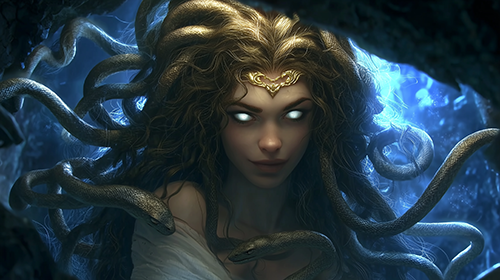
Medusa is one of the most recognizable figures in Greek mythology. With snakes instead of hair and a gaze said to turn anyone who looked directly at her into stone, she became one of the most famous monsters of the ancient Greek world.
However, the story of Medusa is more complicated than the image of a simple monster. Ancient sources tell different versions of her story, and later interpretations have transformed her into a symbol of danger, protection, beauty, suffering, and power.
Who Was Medusa?
Medusa was one of the three Gorgons in Greek mythology. Her sisters were Stheno and Euryale. Unlike her sisters, who were generally described as immortal, Medusa was mortal.
The Gorgons were frightening supernatural beings associated with terrifying appearances and extraordinary powers. Medusa became the most famous of the three because she could turn people to stone with her gaze.
Her name has become synonymous with one of mythology's most memorable monsters.
What Did Medusa Look Like?
Medusa's appearance became increasingly distinctive through ancient art and literature.
She was commonly associated with:
- Snakes for hair
- A frightening face
- Large teeth or tusks in some artistic traditions
- A protruding tongue
- Wings in certain representations
Not every ancient depiction showed Medusa exactly the same way. Greek artists represented Gorgons differently depending on the period and artistic style.
The frightening appearance served an important symbolic purpose: it was designed to scare away evil and protect those who encountered her image.
Medusa's Deadly Gaze
Medusa's most famous ability was her petrifying gaze. Anyone who looked directly at her was said to be transformed into stone.
This power made Medusa particularly difficult to defeat. A normal warrior could not simply fight her face-to-face because doing so would result in death.
The deadly gaze is also what makes her story so memorable. Instead of relying only on physical strength, the hero who defeats Medusa must use intelligence and strategy.
The Story of Perseus and Medusa
The most famous story involving Medusa is the adventure of Perseus.
Perseus was given the seemingly impossible task of obtaining Medusa's head. Directly confronting her would have been extremely dangerous because of her petrifying gaze.
According to the myth, Perseus received divine assistance. Athena provided guidance, while Hermes helped him with magical equipment.
Perseus approached Medusa while she was asleep. Rather than looking directly at her, he used a reflective surface to see her image and carefully cut off her head.
This allowed him to defeat Medusa without meeting her gaze.
Athena and the Shield
One of the most important elements of the Perseus story is the polished shield associated with Athena.
Instead of looking directly at Medusa, Perseus used the reflective surface to observe her movements. This allowed him to navigate the danger of her gaze.
The episode highlights an important theme in Greek mythology: intelligence can overcome a seemingly unbeatable enemy.
Perseus did not defeat Medusa simply because he was stronger. He succeeded because he had the right tools, assistance, and strategy.
What Happened After Medusa's Death?
Medusa's story did not end with her death.
According to the myth, the winged horse Pegasus and the warrior Chrysaor emerged from Medusa's body after Perseus killed her. Both were connected to Poseidon in the mythology surrounding Medusa.
Perseus also carried Medusa's severed head with him because it retained its petrifying power.
This made the head itself a powerful supernatural weapon.
Medusa's Head and the Aegis
Medusa's head became closely associated with Athena. In many artistic traditions, the goddess is shown wearing or carrying the aegis decorated with the head of Medusa.
The image was known as the Gorgoneion.
Rather than representing only fear and death, the Gorgoneion could function as a protective symbol. Its terrifying appearance was believed to frighten away enemies and evil forces.
This creates an interesting contrast: Medusa's frightening image could be used as a symbol of protection.
Was Medusa Always a Monster?
One of the most interesting questions about Medusa concerns her origins.
Some ancient Greek traditions simply present Medusa as a Gorgon without providing the detailed human backstory that appears in later versions.
A famous later tradition, associated with the Roman poet Ovid, describes Medusa as a beautiful woman who was transformed after an encounter involving Athena and Poseidon.
This version became extremely influential in later European art and literature.
Because different ancient and later sources tell different stories, it is important not to treat every version of Medusa's biography as if it came from the same original tradition.
Medusa as a Symbol
Medusa has developed many symbolic meanings throughout history.
Her image has been associated with:
- Danger and fear
- Protection
- Female power
- Transformation
- Punishment
- Beauty and terror
- The consequences of confronting the unknown
The protective use of the Gorgoneion is particularly important. A frightening face could be used to ward off danger, turning fear itself into a form of protection.
Medusa in Ancient Greek Art
Medusa appeared frequently in ancient Greek art. Her face could be found on shields, pottery, architectural decorations, coins, and other objects.
The Gorgon image was especially useful as a protective emblem. Its terrifying appearance was intended to repel enemies and supernatural threats.
This demonstrates that Medusa was more than a character in a story. Her image had a practical symbolic function within ancient Greek culture.
Medusa in Modern Culture
Medusa remains extremely popular today. Her story has inspired novels, films, television shows, video games, paintings, sculptures, and fashion.
Modern interpretations often focus on different aspects of her character. Some portray her primarily as a monster, while others emphasize her transformation, victimhood, resilience, or power.
This ability to support different interpretations is one reason Medusa continues to attract attention thousands of years after her story first became popular.
Why Is Medusa So Famous?
Medusa's story combines several elements that make mythology memorable: supernatural power, danger, tragedy, heroic adventure, and transformation.
Her deadly gaze creates an unusual challenge for the hero. Perseus cannot defeat her through a conventional battle. He must find another way.
At the same time, Medusa's complicated history allows modern audiences to ask deeper questions about justice, identity, power, and how stories change over time.
Yorumlar