 (1).webp)
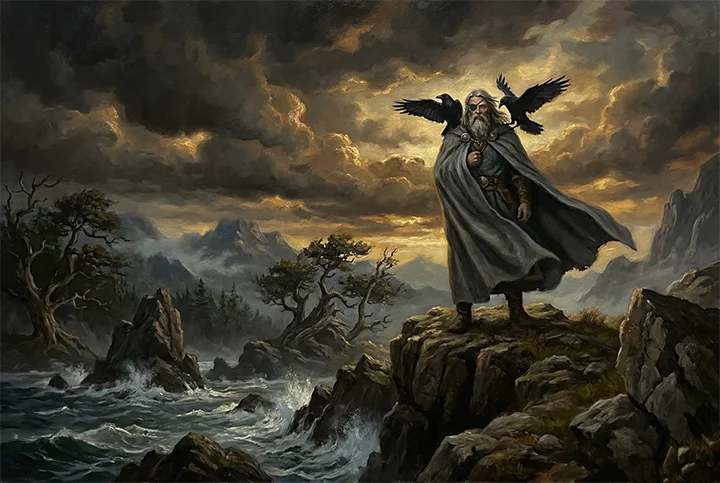
Odin: The Allfather of Norse Gods
Odin is one of the most important and complex figures in Norse mythology. Known as the Allfather, he is associated with wisdom, war, poetry, magic, death, and knowledge. Unlike gods who represent only one particular aspect of life, Odin has many different roles and characteristics.
He is the ruler of the gods in many Norse traditions and is closely connected with Asgard, the realm of the gods. His search for knowledge often leads him to make extraordinary sacrifices, making wisdom one of the defining themes of his mythology.
Who Was Odin?
Odin was a major god in the religious traditions of the ancient Norse and other Germanic peoples. He is generally described as the son of the god Borr and the giantess Bestla.
His brothers were Vili and Vé. Together, the three brothers play an important role in the Norse creation story.
Odin is often described as the father or ancestor of several important gods, which is one reason he became known as the Allfather.
Odin and the Creation of the World
According to Norse mythology, Odin and his brothers played a major role in creating the world from the body of the primordial being Ymir.
After Ymir was defeated, his body was used to form different parts of the cosmos. His flesh became the land, his blood became the seas, and other parts of his body were transformed into elements of the world.
The brothers then established the structure of the cosmos and created a world in which gods, humans, giants, and other beings would have their respective places.
Odin and His Search for Wisdom
Perhaps the most important characteristic of Odin is his endless desire for knowledge.
Odin was willing to make extraordinary sacrifices to gain wisdom. One of the most famous stories describes how he sacrificed one of his eyes in exchange for drinking from Mímir's well.
The well contained profound knowledge, and Odin believed that gaining wisdom was worth the personal sacrifice.
The story demonstrates that Odin's power did not come only from strength or authority. Knowledge itself was one of his greatest sources of power.
Odin and the Runes
Odin is strongly associated with the runes, the writing system used by various Germanic peoples.
In Norse mythology, Odin gained knowledge of the runes through another dramatic sacrifice. He hung himself on the World Tree, Yggdrasil, and remained there for nine nights, wounded by a spear.
Through this ordeal, he gained knowledge of the runes and their mysteries.
The story reflects one of the central themes of Odin's mythology: knowledge often requires sacrifice, suffering, and determination.
Odin's Ravens: Huginn and Muninn
Odin is famously accompanied by two ravens named Huginn and Muninn.
Their names are commonly interpreted as being connected with thought and memory.
According to Norse mythology, the ravens traveled throughout the world and returned to Odin with information about what they had seen.
They therefore represented Odin's desire to observe and understand everything happening across the cosmos.
The image of Odin with his two ravens became one of the most recognizable representations of the god.
Odin's Wolves
Odin is also associated with two wolves named Geri and Freki.
The wolves accompany him and are traditionally described as receiving food from Odin while he survives on wine.
Wolves were powerful and significant animals in Norse mythology, and their connection with Odin reinforces his association with wilderness, warfare, death, and supernatural forces.
Gungnir: Odin's Magical Spear
One of Odin's most famous possessions is Gungnir, a magical spear.
According to Norse mythology, Gungnir was created by dwarven craftsmen and possessed extraordinary accuracy. It was said that the spear would never miss its target.
Gungnir represented Odin's authority and his connection with warfare. It also appears in stories involving sacrifices and divine conflicts.
Odin and Magic
Odin was strongly associated with magic, particularly a form of magic known as seiðr.
This type of magic was connected with prophecy, fate, and supernatural knowledge. In some traditions, Odin learned seiðr from Freyja.
His association with magic is particularly interesting because seiðr was sometimes culturally associated with women, making Odin's practice of it unusual within the social expectations represented in Norse literature.
Odin and Poetry
Odin was also associated with poetry and inspiration.
One famous Norse myth tells how Odin obtained the Mead of Poetry, a magical substance that granted wisdom and poetic ability.
After obtaining the mead, Odin brought it to the gods and became closely associated with poetic inspiration.
This connection gives Odin another dimension beyond his role as a warrior and ruler. He was also a god of creativity, language, knowledge, and inspiration.
Odin and War
Odin had a powerful connection with warfare. Warriors who died in battle were sometimes believed to have been chosen by divine forces and taken to the afterlife.
According to Norse mythology, Odin presided over Valhalla, the great hall where selected warriors could spend the afterlife.
There, the warriors were said to feast and train for the events of Ragnarök.
Odin's relationship with war was therefore closely connected to fate and the final destruction of the existing cosmic order.
Odin and Valhalla
Valhalla is one of the most famous locations in Norse mythology.
The hall is associated with Odin and the warriors known as the Einherjar. These warriors were believed to prepare for the final battle of Ragnarök.
The Valkyries played an important role in choosing some of those who died in battle and bringing them to Odin's hall.
Valhalla therefore represents more than an afterlife of celebration. It is also a place connected with preparation for the final conflict.
Odin's Family
Odin's family includes many important figures in Norse mythology.
His wife is Frigg, one of the major goddesses associated with marriage, motherhood, and foresight.
Odin is also traditionally described as the father of several important gods, including:
- Thor
- Baldr
- Höðr
- Váli
- Vidar
Different sources provide different genealogical details, so not every tradition describes Odin's family in exactly the same way.
Odin and Thor
Thor is perhaps Odin's most famous son in modern popular culture.
While Odin is associated with wisdom, magic, war, and knowledge, Thor is primarily associated with strength, thunder, protection, and the defense of the gods and humanity.
Their contrasting qualities make them two of the most important figures in Norse mythology.
Odin and Ragnarök
Odin plays a major role in the events surrounding Ragnarök, the catastrophic series of events that leads to the destruction and transformation of the mythological world.
Odin knows that Ragnarök is approaching, but knowledge of the future does not allow him to simply prevent it.
During the final conflict, Odin faces the monstrous wolf Fenrir.
According to the traditional myth, Fenrir eventually kills Odin.
The story emphasizes one of the most important themes in Norse mythology: even the gods cannot completely escape fate.
Why Odin Is Called the Allfather
The title "Allfather" reflects Odin's position as a father figure and ancestor within the Norse divine family.
However, the title does not mean that every being in Norse mythology was literally his child. It reflects his role as a powerful patriarchal deity and a central figure among the gods.
Odin's many associations with creation, wisdom, kingship, magic, poetry, war, and death make the title particularly fitting within the mythology.
Odin's Appearance and Symbols
Odin is commonly depicted as an older man with a long beard and one eye. He is often shown wearing a wide-brimmed hat or traveling cloak.
Important symbols associated with him include:
- Ravens
- Wolves
- Gungnir
- The runes
- The World Tree
- One eye
- The Valkyries
These symbols reflect the different aspects of Odin's character and mythology.
Odin in Modern Culture
Odin remains one of the most recognizable Norse gods in modern culture. He appears in novels, films, television series, comics, video games, and other forms of entertainment.
Modern portrayals often focus on his role as a powerful father and ruler, while traditional Norse mythology presents a more complicated figure who is constantly searching for knowledge and attempting to understand fate.
The historical Odin was part of a much broader religious tradition than the simplified versions often seen in modern entertainment.
Yorumlar