 (1).webp)
Poseidon and the Secrets of the Sea
Poseidon and the Secrets of the Sea
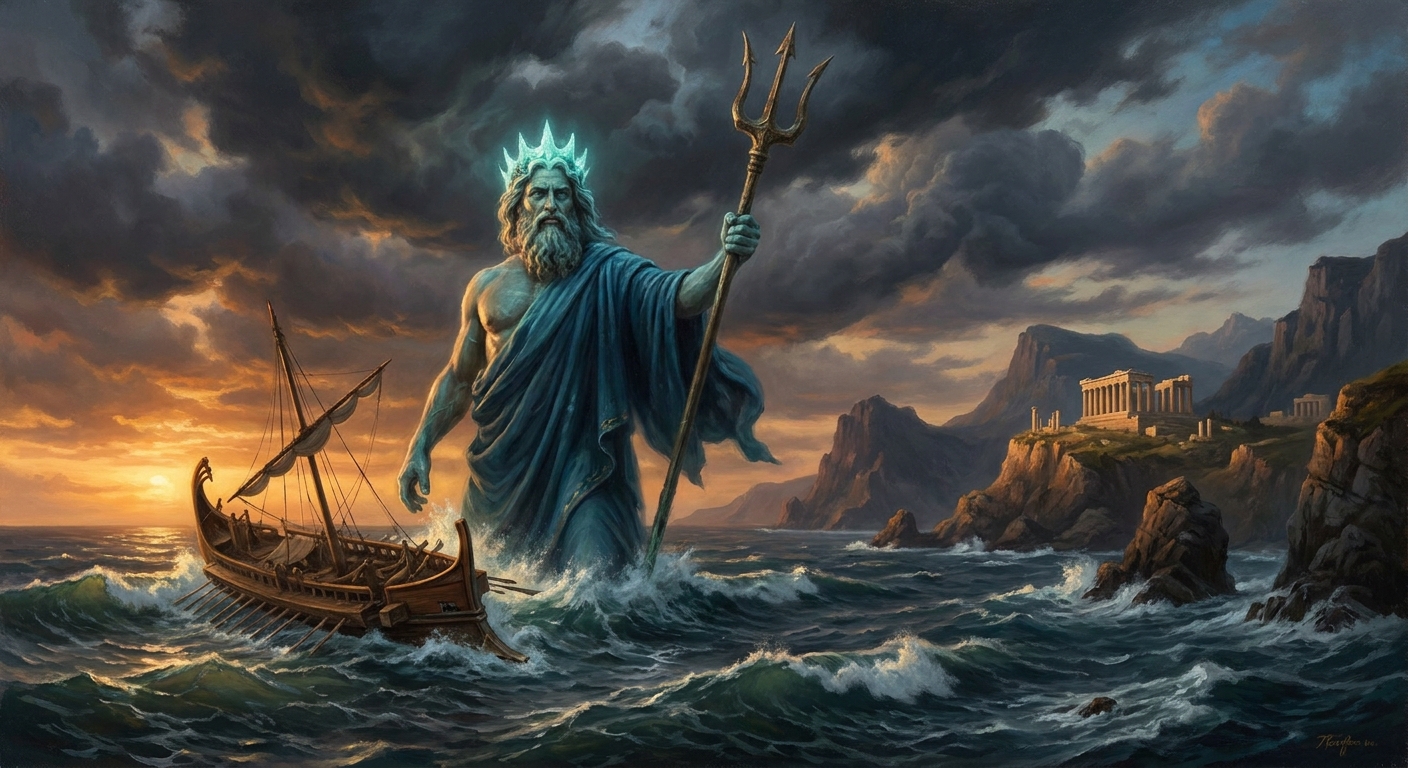
Poseidon is one of the most powerful gods in Greek mythology. Known primarily as the god of the sea, he was also associated with earthquakes, storms, horses, and other forces of nature. As one of the three sons of Cronus and Rhea, Poseidon became one of the most important deities in the Greek pantheon.
Ancient Greeks lived closely connected to the sea, making Poseidon an especially significant figure. Sailors prayed to him for safe journeys, while coastal communities respected his unpredictable and sometimes destructive power.
Who Was Poseidon?
Poseidon was the brother of Zeus, Hades, Hera, Demeter, and Hestia. According to Greek mythology, his father Cronus swallowed his children because he feared they would eventually overthrow him.
Zeus later escaped and helped free his siblings. Together, the younger gods fought against the Titans in the Titanomachy. After their victory, Zeus, Poseidon, and Hades divided the cosmos among themselves.
Zeus received authority over the sky, Hades became ruler of the Underworld, and Poseidon received dominion over the sea.
Poseidon and the Power of the Sea
The sea was central to ancient Greek civilization. It provided food, transportation, trade routes, and connections between distant communities. At the same time, storms and rough waters could make sea travel extremely dangerous.
Poseidon represented both sides of the ocean.
He could provide calm waters and favorable conditions, but he could also unleash violent storms and enormous waves. This dual nature reflected the ancient Greek understanding of the sea as both essential and unpredictable.
Poseidon's Famous Trident
The most recognizable symbol of Poseidon is his trident. According to mythology, the Cyclopes gave Zeus, Poseidon, and Hades powerful weapons during their war against the Titans.
Poseidon received the trident, which became a symbol of his authority over the sea.
In myths and artistic representations, Poseidon could use his trident to stir the ocean, create springs, and cause earthquakes. The weapon therefore represented both creation and destruction.
Poseidon as the God of Earthquakes
Although Poseidon is best known as the god of the sea, ancient Greeks also associated him with earthquakes.
His title "Earth-Shaker" reflects this aspect of his power. When earthquakes occurred, they could be interpreted as manifestations of Poseidon's anger or divine activity.
This connection was particularly significant in a region where earthquakes were relatively common.
Poseidon and Horses
Another surprising aspect of Poseon's mythology is his connection with horses. Ancient traditions associated him with horses and equestrian culture in addition to the sea.
Some myths describe Poseidon as the creator or father of the first horse. His association with horses demonstrates how Greek gods could have several seemingly unrelated domains that were connected through ancient religious traditions.
Poseidon and Athena
One of the most famous stories involving Poseidon concerns his competition with Athena to become the patron deity of Athens.
Both gods wanted to offer the city a gift. Poseidon struck the ground with his trident and produced a source of water, although in some versions it was salt water. Athena offered an olive tree.
The olive tree was considered more useful to the citizens, providing food, oil, wood, and economic value. Athena therefore became the city's patron goddess.
The story explains the special relationship between Athena and Athens while also highlighting the different qualities represented by the two deities.
Poseidon and Odysseus
Poseidon plays an important role in Homer's Odyssey. His conflict with Odysseus becomes one of the major obstacles in the hero's long journey home.
After Odysseus blinds Polyphemus, a Cyclops who is traditionally described as Poseidon's son, Poseidon becomes hostile toward him.
The god then makes Odysseus's journey home extremely difficult. Storms, delays, and disasters repeatedly prevent the hero from reaching Ithaca.
This story demonstrates Poseidon's role as a powerful and unpredictable force of the sea.
Poseidon and the Trojan War
Poseidon also appears in stories connected to the Trojan War. His relationship with Troy is complicated, and he does not always remain on the same side as the other gods.
In one famous myth, Poseidon and Apollo were forced to serve the Trojan king Laomedon. They helped construct the walls of Troy, but the king later refused to give them the promised reward.
Poseidon became angry and sent a sea monster to threaten the city.
His involvement in the Trojan stories once again shows how easily divine anger could influence the fate of humans.
Poseidon and Sea Creatures
As ruler of the sea, Poseidon was naturally connected with many marine creatures and supernatural beings.
Greek mythology includes numerous sea-related figures, including Nereids, sea monsters, and other divine beings. Poseidon could command or influence the forces of the ocean, making him one of the central figures in the mythology of the sea.
These stories reflect the ancient Greeks' fascination with the mysterious world beneath the water.
Poseidon's Family
Poseidon had relationships with several goddesses and mortal women, resulting in numerous children in different mythological traditions.
Among the figures associated with Poseidon are:
- Triton, a sea god
- Polyphemus, the famous Cyclops
- Pegasus, in certain traditions connected to Medusa
- Theseus, who was sometimes described as Poseidon's son
Different ancient sources provide varying versions of these relationships and genealogies, which is common in Greek mythology.
Why Was Poseidon So Important to the Ancient Greeks?
The importance of Poseidon was closely connected to the geography and economy of ancient Greece.
The Greek world consisted of numerous islands and coastal settlements. Ships were essential for trade, travel, fishing, and communication.
For sailors, the sea could determine their survival. Worshipping Poseidon was therefore not simply about mythology; it was connected to real concerns about weather, navigation, and maritime life.
Symbols of Poseidon
Several symbols are strongly associated with Poseidon:
- The trident
- Horses
- Dolphins
- Bulls
- Waves and the ocean
The trident is by far his most recognizable symbol, while horses and marine animals reflect different aspects of his mythology.
Poseidon in Modern Culture
Poseidon continues to appear in modern books, movies, television series, and video games. His association with the sea makes him particularly recognizable in fantasy and adventure stories.
Modern portrayals sometimes simplify his personality, but the traditional image of a powerful god carrying a trident remains one of the most recognizable representations of Greek mythology.
Yorumlar