 (1).webp)
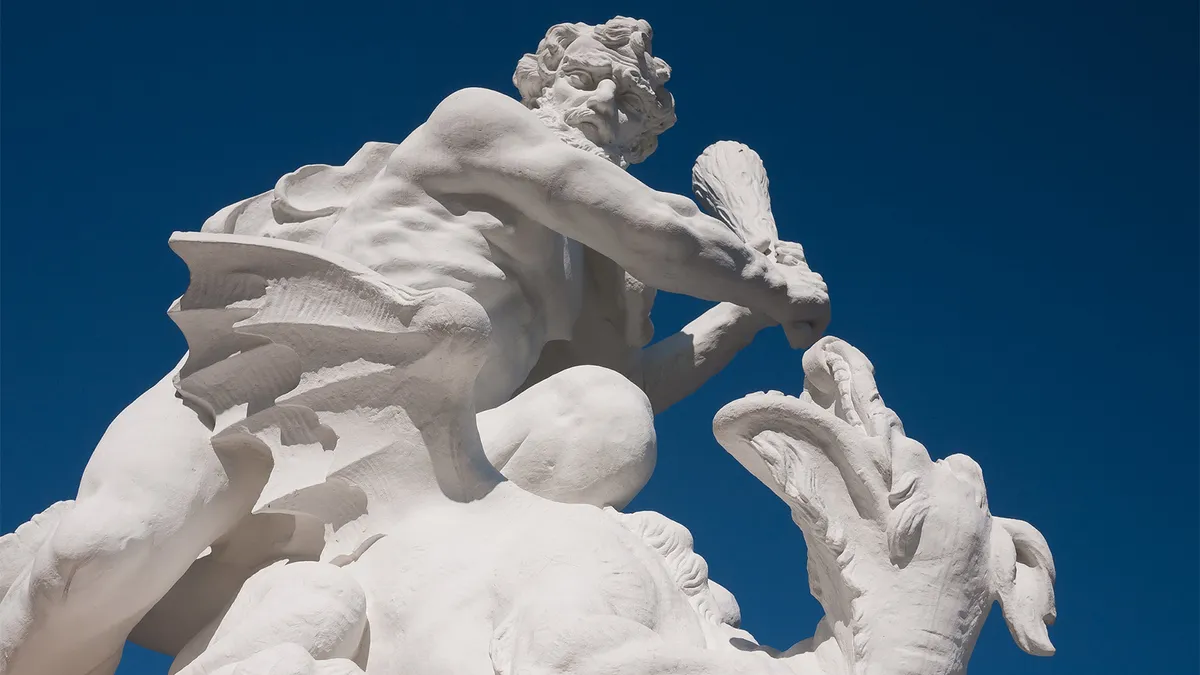
The Myth of Hercules and His Twelve Labors
The Myth of Hercules and His Twelve Labors
Hercules, known as Heracles in Greek mythology, is one of the most famous heroes of the ancient world. Celebrated for his extraordinary strength, courage, and determination, Hercules became legendary because of the Twelve Labors he was forced to complete.
These difficult tasks were designed to test the limits of his strength and endurance. Along the way, Hercules faced terrifying creatures, dangerous environments, and seemingly impossible challenges. His story remains one of the most enduring heroic tales in Greek mythology.
Who Was Hercules?
Hercules was the son of Zeus and the mortal woman Alcmene. His divine ancestry gave him extraordinary abilities, but his life was far from easy.
Hera, the wife of Zeus, was hostile toward Hercules because of his father's relationship with Alcmene. According to mythology, her anger contributed to many of the difficulties he experienced throughout his life.
Despite his immense physical strength, Hercules was also portrayed as a flawed human being who made serious mistakes and suffered the consequences.
Why Did Hercules Have to Complete the Twelve Labors?
The Twelve Labors were connected to a period of suffering and punishment in Hercules's life. After a tragic episode in which he lost control and killed his wife and children, Hercules sought purification and guidance.
He was instructed to serve King Eurystheus of Tiryns and complete a series of difficult tasks. What began as a form of punishment eventually became the greatest demonstration of his courage and perseverance.
The exact order and details of the Labors can vary between ancient sources, but the traditional list contains twelve major challenges.
1. The Nemean Lion
Hercules's first Labor was to defeat the Nemean Lion, a monstrous creature whose skin could not be penetrated by ordinary weapons.
Hercules initially attempted to fight it using conventional weapons, but they proved ineffective. He eventually defeated the lion through his immense physical strength.
Afterward, he used the lion's own claws to remove its nearly invulnerable hide. Hercules later wore the skin as armor, making it one of his most recognizable symbols.
2. The Lernaean Hydra
The second Labor required Hercules to defeat the Lernaean Hydra, a serpent-like monster with multiple heads.
The challenge became even more difficult because cutting off one head could cause additional heads to appear. Hercules received assistance from his nephew Iolaus, who helped prevent the wounds from producing new heads.
The Hydra became one of the most famous monsters in Greek mythology and remains closely associated with Hercules.
3. The Ceryneian Hind
For his third Labor, Hercules was ordered to capture the Ceryneian Hind, a sacred deer associated with Artemis.
Unlike the previous challenges, Hercules was expected to capture the animal without killing it.
The task required patience and persistence because the hind was extremely fast and difficult to catch. Hercules eventually succeeded after pursuing it for a long time.
4. The Erymanthian Boar
Hercules's fourth Labor involved capturing the enormous Erymanthian Boar.
He was required to bring the animal back alive. Hercules eventually trapped the boar in deep snow and carried it back to Eurystheus.
The story demonstrates that the Labors were not always about defeating monsters. Some required cleverness, patience, and careful planning.
5. Cleaning the Augean Stables
The fifth Labor was one of the most unusual. Hercules was ordered to clean the enormous stables of King Augeas in a single day.
The stables had not been cleaned for many years and contained an extraordinary amount of waste.
Instead of trying to remove everything by hand, Hercules used his intelligence. He redirected the courses of two rivers, causing the water to flow through the stables and wash them clean.
This Labor highlights Hercules's ability to solve problems through strategy rather than physical strength alone.
6. The Stymphalian Birds
The sixth Labor required Hercules to drive away or defeat the Stymphalian Birds, dangerous creatures with metallic feathers and weapons-like beaks.
Hercules was given a special tool by Athena that helped him frighten the birds from their hiding place.
He then attacked the creatures as they flew into the open, defeating many of them and driving the rest away.
7. The Cretan Bull
Hercules's seventh Labor was to capture the Cretan Bull alive and bring it back to Eurystheus.
The bull was a powerful and dangerous animal associated with Crete. Hercules managed to capture it and transport it back to the Greek mainland.
The creature was later released and became connected to another famous Greek myth involving Theseus.
8. The Mares of Diomedes
The eighth Labor involved capturing the terrifying horses belonging to King Diomedes of Thrace.
These horses were famous for their violent behavior and were said to feed on human flesh.
Hercules eventually overcame both the horses and their owner. He then brought the animals back as proof that he had completed the task.
9. The Belt of Hippolyta
For the ninth Labor, Hercules was ordered to obtain the belt of Hippolyta, queen of the Amazons.
Hippolyta initially agreed to give him the belt, but a series of misunderstandings and divine interference turned the mission into a conflict.
Hercules eventually obtained the belt, although different versions of the story describe the events differently.
The myth is particularly interesting because it introduces the legendary Amazons, a group of warrior women who appear in several Greek stories.
10. The Cattle of Geryon
The tenth Labor required Hercules to travel to the distant western edge of the known world and bring back the cattle of Geryon.
Geryon was a monstrous figure with multiple bodies or heads in different descriptions. Hercules faced both Geryon and the herdsman's guardian before successfully taking the cattle.
The journey itself was considered one of the greatest adventures of his Labors.
11. The Apples of the Hesperides
The eleventh Labor involved obtaining the golden apples kept in a sacred garden belonging to the Hesperides.
The apples were connected to the gods and were protected by supernatural guardians. In some traditions, a dragon named Ladon guarded them.
Hercules needed to use intelligence and assistance to obtain the apples. One famous version involves the Titan Atlas, who temporarily carried the heavens while Hercules retrieved the apples.
12. Cerberus and the Underworld
The final Labor was perhaps the most dangerous. Hercules was ordered to travel into the Underworld and bring back Cerberus, the monstrous three-headed dog who guarded the realm of the dead.
Entering the Underworld was an extraordinary challenge because few living mortals were believed capable of doing so.
With divine permission and his legendary strength, Hercules managed to capture Cerberus and bring him to the surface without using weapons.
After showing Cerberus to Eurystheus, Hercules returned the creature to the Underworld.
What Do the Twelve Labors Represent?
The Twelve Labors are more than a series of physical challenges. They can also be interpreted as stories about overcoming hardship, accepting responsibility, and transforming through suffering.
Hercules repeatedly faces situations that appear impossible. Instead of giving up, he continues despite danger and uncertainty.
The Labors therefore represent themes such as:
- Courage
- Perseverance
- Strength
- Intelligence
- Redemption
- Responsibility
- Overcoming adversity
These themes help explain why Hercules has remained popular for thousands of years.
Hercules as a Greek Hero
Hercules is different from many modern heroes because he is not portrayed as perfect. He has extraordinary strength but also makes serious mistakes.
His journey is therefore not simply about becoming powerful. It is about dealing with the consequences of his actions and attempting to overcome his past.
This combination of strength and human weakness makes Hercules one of the most complex heroes in Greek mythology.
The Legacy of Hercules
The story of Hercules has survived through countless generations. His Twelve Labors have inspired ancient artworks, poems, plays, novels, films, television shows, and video games.
Different cultures have adapted the character according to their own storytelling traditions. Despite these changes, the central idea remains the same: a hero faces seemingly impossible challenges and refuses to surrender.
Yorumlar