 (1).webp)
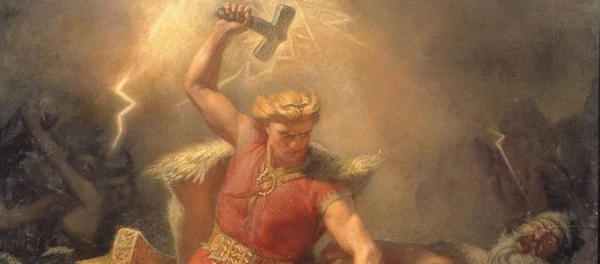
Thor and the Power of Mjölnir
Thor and the Power of Mjölnir
Thor is one of the most recognizable gods in Norse mythology, known for his immense strength, fearless nature, and powerful connection to thunder and storms. At the center of many stories about Thor is Mjölnir, his legendary hammer. More than a simple weapon, Mjölnir represents protection, strength, divine authority, and Thor’s role as a defender of gods and humans.
The stories surrounding Thor and Mjölnir have survived for centuries and remain an important part of Norse mythology. Understanding the relationship between the god and his hammer provides a deeper look into the beliefs, symbols, and stories of the Viking Age.
Who Was Thor?
Thor was one of the major gods in Norse mythology and was associated with thunder, lightning, storms, strength, and protection. He was the son of Odin, the Allfather, and the giantess Jörð, whose name is connected with the earth.
Unlike Odin, who was strongly associated with wisdom, magic, knowledge, and prophecy, Thor was primarily known for physical strength and his willingness to confront dangerous enemies. He was considered a powerful protector of the gods and humanity against the forces of chaos.
Thor frequently traveled through the worlds of Norse mythology, often encountering giants and other supernatural beings. His adventures demonstrate both his enormous physical power and his determination to defend the established order.
What Is Mjölnir?
Mjölnir is the magical hammer belonging to Thor. Its name is commonly associated with the idea of crushing or grinding, which reflects the destructive force attributed to the weapon.
Mjölnir was not an ordinary hammer. In mythological stories, it possessed supernatural qualities that made it one of the most powerful objects in the Norse cosmos.
Thor could use Mjölnir to strike his enemies with tremendous force, and the hammer was closely connected to thunder and lightning. After being thrown, Mjölnir could return to Thor's hand, making it an exceptionally effective weapon.
The hammer was also associated with protection and blessing, meaning its importance went beyond combat.
How Was Mjölnir Created?
One of the most famous stories about Mjölnir's creation appears in Norse mythology through a contest involving the dwarven craftsmen Brokkr and Sindri.
The story begins when Loki causes trouble by cutting off the golden hair of Thor's wife, Sif. To repair the situation, Loki seeks the help of skilled dwarves. He becomes involved in a challenge in which dwarven craftsmen attempt to create remarkable treasures for the gods.
During the process, Brokkr and Sindri create several extraordinary objects. Among them is Mjölnir.
However, Loki interferes with the crafting process by taking the form of a fly and attempting to distract the craftsmen. His interference causes a problem with the hammer's handle, which ends up shorter than originally intended.
Despite this imperfection, Mjölnir becomes an extraordinarily powerful weapon and ultimately belongs to Thor.
The Powers of Mjölnir
Mjölnir possesses several important abilities in Norse mythology.
Incredible Destructive Power
Thor uses Mjölnir to defeat giants, monsters, and other supernatural enemies. The hammer represents overwhelming physical force and allows Thor to challenge opponents that ordinary weapons could never defeat.
Returning to Thor
One of Mjölnir's most famous characteristics is its ability to return to Thor after being thrown. This makes the hammer different from conventional weapons and emphasizes its supernatural nature.
Connection to Thunder
Mjölnir is strongly associated with Thor's control over thunder and storms. Although modern interpretations often portray the hammer as directly producing lightning, the original myths present a broader symbolic relationship between Thor, the hammer, thunder, and destructive natural forces.
Protection
Mjölnir was not simply an instrument of destruction. It also represented protection. Thor used his hammer to defend the gods and humans from giants and other dangerous forces.
This protective role became one of the most important aspects of the hammer's symbolism.
Thor's Other Magical Equipment
Mjölnir was not Thor's only extraordinary possession. Norse mythology also describes other magical objects associated with him.
One was Megingjörð, a magical belt that increased Thor's already immense strength. He also possessed special iron gloves known as Járngreipr, which were useful when handling Mjölnir.
Together, these objects helped establish Thor as one of the most physically powerful figures in Norse mythology.
Thor's Battles Against the Giants
Many stories involving Thor and Mjölnir revolve around his conflicts with giants. In Norse mythology, giants were not simply large humans. They represented powerful supernatural forces that frequently stood in opposition to the gods.
Thor's hammer gave him a crucial advantage in these confrontations.
One famous example is the story of Þrymr, a giant who steals Mjölnir. He demands Freyja as a bride in exchange for returning the hammer. When Freyja refuses, Thor eventually disguises himself as Freyja and travels to the giant's hall.
During the wedding feast, Thor's enormous appetite nearly reveals his identity. Eventually, Mjölnir is brought out as part of the wedding ceremony. Once Thor gets hold of the hammer, his disguise is no longer important. He uses Mjölnir to defeat Þrymr and his companions.
The story combines humor, deception, and violence while demonstrating how essential Mjölnir is to Thor.
Mjölnir as a Symbol of Protection
Mjölnir became more than a mythological weapon. Archaeological discoveries show that hammer-shaped pendants were worn in the Viking Age.
These objects are commonly interpreted as symbols connected with Thor and may have served as protective or religious symbols. Wearing a hammer pendant could express an individual's connection with the traditions associated with Thor.
This helps explain why Mjölnir remained culturally important beyond the stories themselves.
Mjölnir and Norse Religious Traditions
The hammer was also connected with important religious and social rituals. Thor was associated with protection, fertility, strength, and the maintenance of order.
Mjölnir could therefore represent more than warfare. Its symbolic meaning included protection of communities, sacred spaces, and social traditions.
The hammer's significance can be understood partly through the broader role of Thor in Norse religion. While Odin was often associated with elite warriors, wisdom, and mystical knowledge, Thor had a particularly strong connection with ordinary people and the protection of the human world.
Thor and Mjölnir at Ragnarök
Thor's final battle is one of the most dramatic events in Norse mythology.
During Ragnarök, the great conflict that leads to the destruction and transformation of the existing world, Thor faces Jörmungandr, the enormous Midgard Serpent.
Thor succeeds in killing the serpent with Mjölnir. However, the serpent's venom proves fatal. After defeating his enemy, Thor takes only a few steps before collapsing and dying from the poison.
This event illustrates one of the central themes of Norse mythology: even the strongest gods cannot escape fate.
Mjölnir remains a symbol of Thor's strength until the very end of his story.
Why Is Mjölnir So Important?
Mjölnir is important because it represents several ideas at the same time.
It represents strength, because Thor uses it against powerful supernatural enemies.
It represents protection, because Thor's role is largely centered on defending gods and humans.
It represents divine authority, because it is the weapon of one of the most important gods in the Norse pantheon.
It also represents order against chaos, as Thor repeatedly confronts forces that threaten the worlds inhabited by gods and humans.
These different meanings explain why Mjölnir became one of the most recognizable symbols of Norse mythology.
Mjölnir in Modern Culture
The image of Thor and Mjölnir has become widely known around the world. Modern books, films, television programs, video games, comics, and other forms of popular culture frequently reinterpret the Norse god and his hammer.
Marvel's version of Thor has played a particularly important role in introducing the character to modern audiences. However, the modern superhero version differs in several important ways from the Thor found in medieval Norse sources.
In the original mythology, Thor is a powerful god associated with thunder, protection, physical strength, and battles against giants and supernatural enemies. Mjölnir is likewise presented as a sacred and magical object rather than simply a superhero weapon.
Understanding the original mythology makes it easier to see how modern adaptations have transformed ancient stories for contemporary audiences.
The Legacy of Thor and Mjölnir
Thor and Mjölnir remain among the most enduring figures and symbols from Norse mythology. Their stories combine adventure, supernatural battles, humor, religious symbolism, and ideas about fate.
Mjölnir is especially significant because it captures many of Thor's defining qualities in a single object. It is powerful but also protective, destructive but also associated with sacred traditions.
For the people who told and preserved these myths, Thor was more than a warrior with a magical hammer. He was a defender who stood between the human world and dangerous supernatural forces. Mjölnir became the clearest symbol of that role.
Today, the hammer continues to represent one of the most recognizable elements of Norse mythology, while the stories of Thor provide a fascinating window into the beliefs and imagination of the medieval Scandinavian world.
Yorumlar